Why Historical Context Matters in Strategic Competition

Why Historical Context Matters in Strategic Competition

Listen to this article:

00:00

Discussions surrounding China often focus on military modernization, Taiwan, industrial policy, and competition across the Indo-Pacific. Those developments influence planning discussions throughout the defense community and shape decisions across government and industry.

During a recent appearance on the Think.Fight.Learn.Repeat. podcast, SPA Wargame Analyst Phillip Colón discussed a topic that receives less attention in many conversations about strategic competition: the role historical context plays in shaping modern Chinese decision-making.

Phillip’s perspective centers on an observation that extends beyond China alone. Nations interpret events through their own historical experiences, political traditions, and national narratives. Those perspectives influence how leaders define national interests, assess risk, and communicate strategic priorities.

Phillip Colón is a Wargame Analyst with SPA's Joint, OSW, and Interagency Division (JOID).
Phillip Colón is a Wargame Analyst with SPA’s Joint, OSW, and Interagency Division (JOID).
Understanding China’s Historical Perspective

For many defense professionals, discussions surrounding force posture, military exercises, economic competition, and gray zone activity naturally begin with the present day. Chinese leaders frequently approach those same topics with historical reference points that stretch back generations and even centuries.

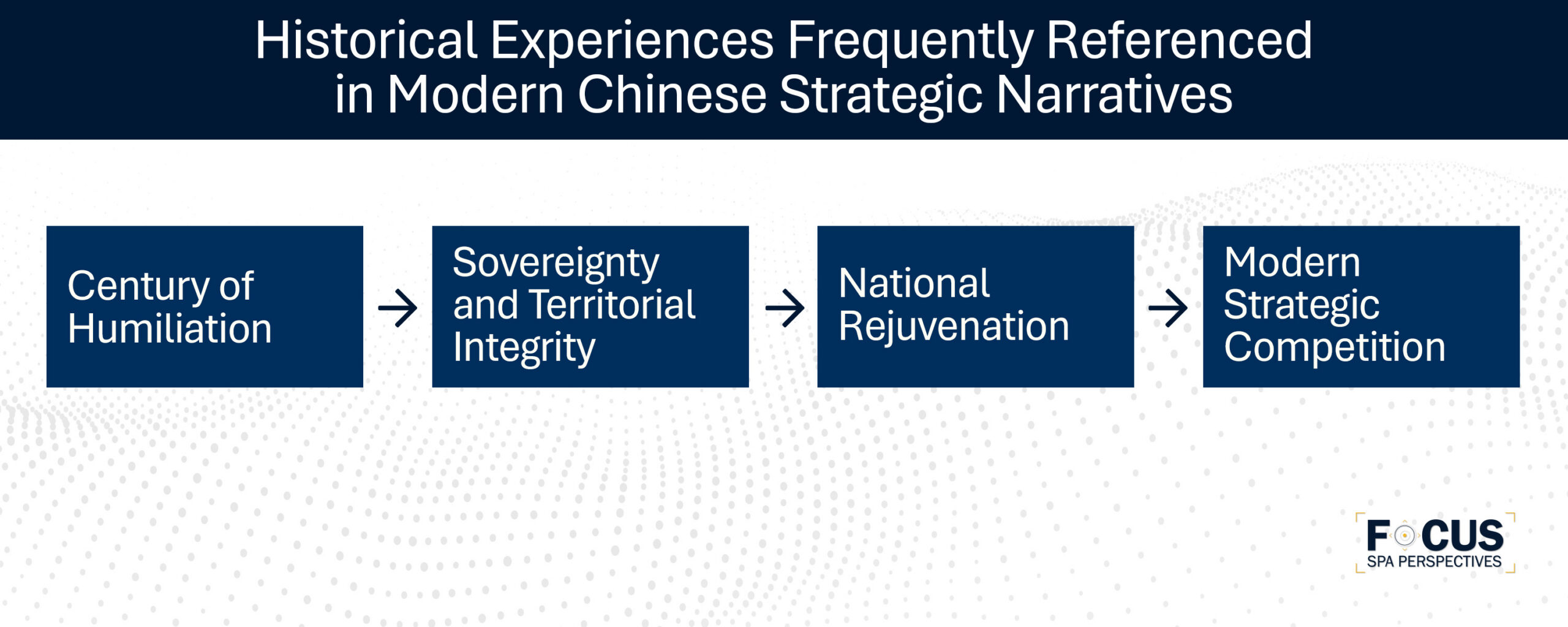
Throughout the discussion, Phillip returned frequently to the influence historical experiences continue to have on Chinese strategic thinking today. One concept surfaced repeatedly: the Century of Humiliation. Chinese scholars use the term to describe the period between 1842 and the establishment of the People’s Republic of China in 1949, when foreign intervention and political fragmentation fundamentally reshaped China’s view of itself and its place in the world.

Phillip explained that many of the themes appearing in Chinese political messaging today, including national rejuvenation, sovereignty, and reunification, are closely tied to the lessons Chinese leaders continue to draw from the Century of Humiliation. The founders of the People’s Republic of China considered those events so significant that they devoted four of the first five paragraphs of the constitution’s preamble to them, underscoring their enduring influence on Chinese political thought and national objectives.

Historical experiences frequently referenced in modern Chinese strategic narratives
Historical experiences frequently referenced in modern Chinese strategic narratives.
That historical perspective also informs the concept of strategic empathy, which Phillip described as an important part of understanding competitors and producing stronger analysis. The concept centers on understanding how another nation interprets its own interests, objectives, and historical experiences, even when those perspectives differ substantially from those held in the West.
SPA branding element for a quotation, a yellow square with a midnight blue quotation mark
“Strategic empathy requires understanding how competitors interpret their own history, interests, and priorities.”

Phillip Colón, SPA Wargame Analyst

Strategic Empathy Improves Competitor Analysis

China’s pursuit of reunification with Taiwan provides one example of how those perspectives can diverge.

Discussions in the West often focus on semiconductor production, military positioning, alliance commitments, and regional stability. Chinese leaders frequently frame the issue through sovereignty, national rejuvenation, and historical experiences associated with the Century of Humiliation. That context influences political messaging, strategic priorities, and assessments of acceptable risk.

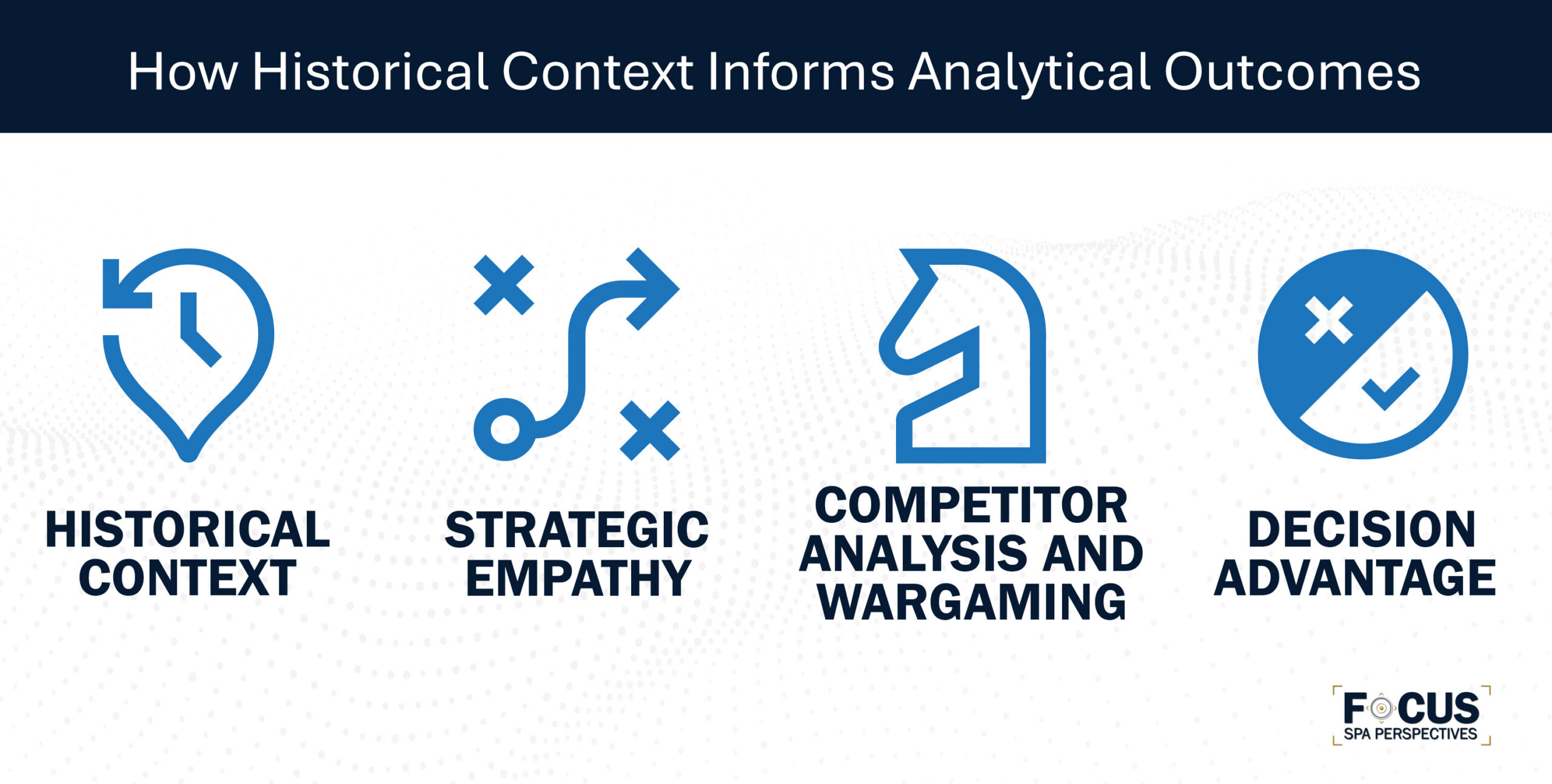
Historical context also shapes analytical work more directly than many practitioners realize.

How historical context informs analytical outcomes.
How historical context informs analytical outcomes. Use a box flow with arrows between each.

Wargames, campaign analyses, and operational studies rely on assumptions about behavior, escalation, incentives, and decision-making. Analysts routinely make judgments about how competitors perceive opportunity, react to uncertainty, and respond to pressure. Historical context often informs those judgments long before a scenario enters execution.

For Phillip, those considerations extend directly into the wargaming environment. Analysts responsible for representing competitors or informing Red decision-making require more than order-of-battle data and capability assessments. Understanding how competitors interpret events and frame decisions influences the realism of scenarios and the quality of the insights generated from them.

Those challenges increasingly shape analytical approaches across SPA.

Applying Historical Context Across Wargaming and Analysis

Within SPA’s Mission and Operations Research Analysis capability, analysts combine modeling, simulation, digital engineering artifacts, intelligence, and operational expertise to evaluate decisions across systems, missions, and campaigns.

Technologies such as AthenaSight™ provide collaborative environments for mission planning, tabletop exercises, and digital wargaming, enabling analysts to examine operational concepts, challenge assumptions, and evaluate decisions before those decisions reach the field.

As strategic competition continues to evolve, defense organizations face an expanding volume of information about competitors and adversaries. Historical context remains an important component of understanding how competitors interpret events, communicate priorities, and approach strategic decisions.


Share

Phillip Colón is a Wargame Analyst with SPA’s Joint, OSW, and Interagency Division (JOID). He holds a Bachelor of Arts in International and Global Studies from American University, where he focused on Sino-American relations and conflict in Southeast Asia and minored in Mandarin.

In this article:
Subscribe to our newsletter

We respect your privacy.

[ Related Articles ]