Building a Representative Problem
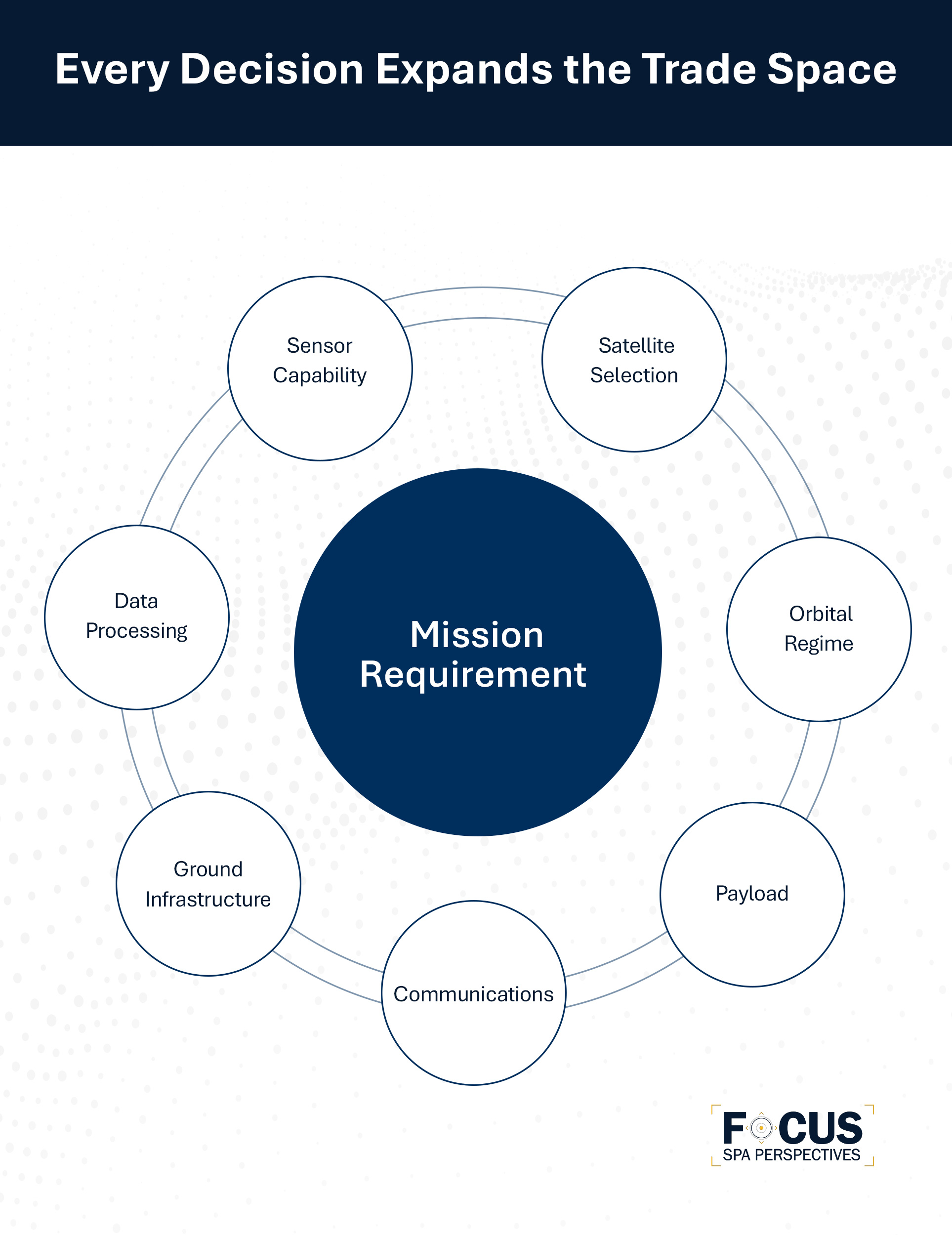
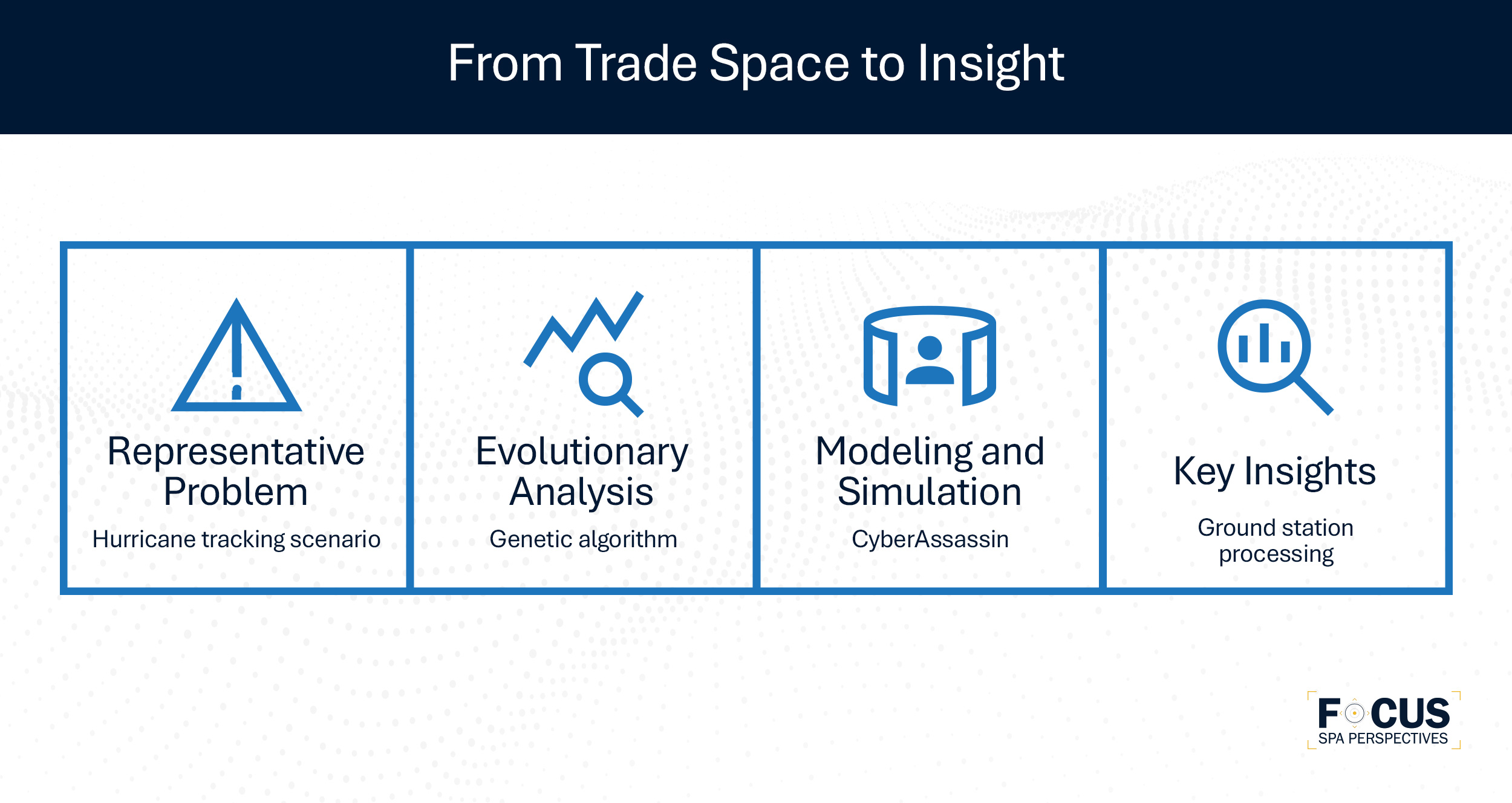
To evaluate the methodology publicly, Shane and Noah developed a notional hurricane tracking scenario that reflected the complexity of a modern satellite service architecture without representing an operational mission. Multiple satellite constellations, orbital regimes, ground stations, communication pathways, and processing timelines created a representative trade space for analysis. Candidate architectures were evaluated against accuracy and latency requirements to identify those capable of meeting mission objectives.
To efficiently navigate the representative trade space, Shane and Noah selected a genetic algorithm capable of producing “good enough, fast enough” solutions while supporting mission-level modeling and simulation. SPA combines operations research with advanced modeling and simulation, leveraging technologies such as CyberAssassinTM and other tools to evaluate complex mission problems and generate decision-quality insight.
The representative problem created a practical way to refine, validate, and discuss the analytical approach within an unclassified environment before applying it elsewhere.
Understanding the Results
Identifying which satellite service architectures were best positioned in both time and space to achieve mission success answered the first analytical question.
The analysis then examined a second question: what characteristics consistently made those architectures successful?
Using Classification and Regression Trees (CART), Shane and Noah identified the attributes that most influenced higher-performing solutions. Within the representative scenario, payload sensor field of regard and ground station processing time emerged as the strongest contributors to architecture performance.
Which satellite service architectures are best positioned to achieve mission success?
What characteristics consistently make those architectures successful, and how can those insights inform future architecture decisions?
The lessons extended beyond the notional scenario. Model inputs proved just as important as the analytical methods themselves. Results remained dependent on the quality of the assumptions, data, and conditions used to build the model.
Looking ahead, Shane and Noah identified additional opportunities to incorporate client preferences, cost analysis, different orbital starting conditions, and comparisons with other evolutionary algorithms.
The same analytical principles extend throughout SPA’s
Mission and Operations Research Analysis capability, where operations research, advanced modeling and simulation, and a
portfolio of technologies including
CyberAssassin™, SPA-developed
STORM and SWIFT, and
AthenaSight™ enable rigorous analysis across complex systems, missions, and campaigns.