00:00
Listen to this article:
The acquisition community has spent decades studying schedule delays, cost growth, technology maturity challenges, and industrial capacity constraints. Yet many of the same issues continue to resurface across programs.
If these challenges are so familiar, why do they continue to disrupt outcomes?
SPA Cost Analysts Gwenevere Tirpak and Russell McCawley explored that question during a recent presentation at the International Cost Estimating and Analysis Association’s (ICEAA) Professional Development & Training Workshop. Using the DDG-1000 program as a case study, the presentation explored how uncertainty can be identified, documented, and evaluated throughout an acquisition program.
Few acquisition programs follow a perfectly predictable path.
Schedules change. Requirements evolve. New technologies take longer than expected to mature. Industrial base constraints affect production timelines. Program priorities shift as conditions change.
While every program is different, many of the factors that create uncertainty look familiar.
The DDG-1000 program offered one example. The analysis examined factors identified in previous program assessments, including scheduling challenges, technology maturity concerns, manufacturing issues, and program management decisions.

Gwenevere Tirpak, SPA Cost Analyst
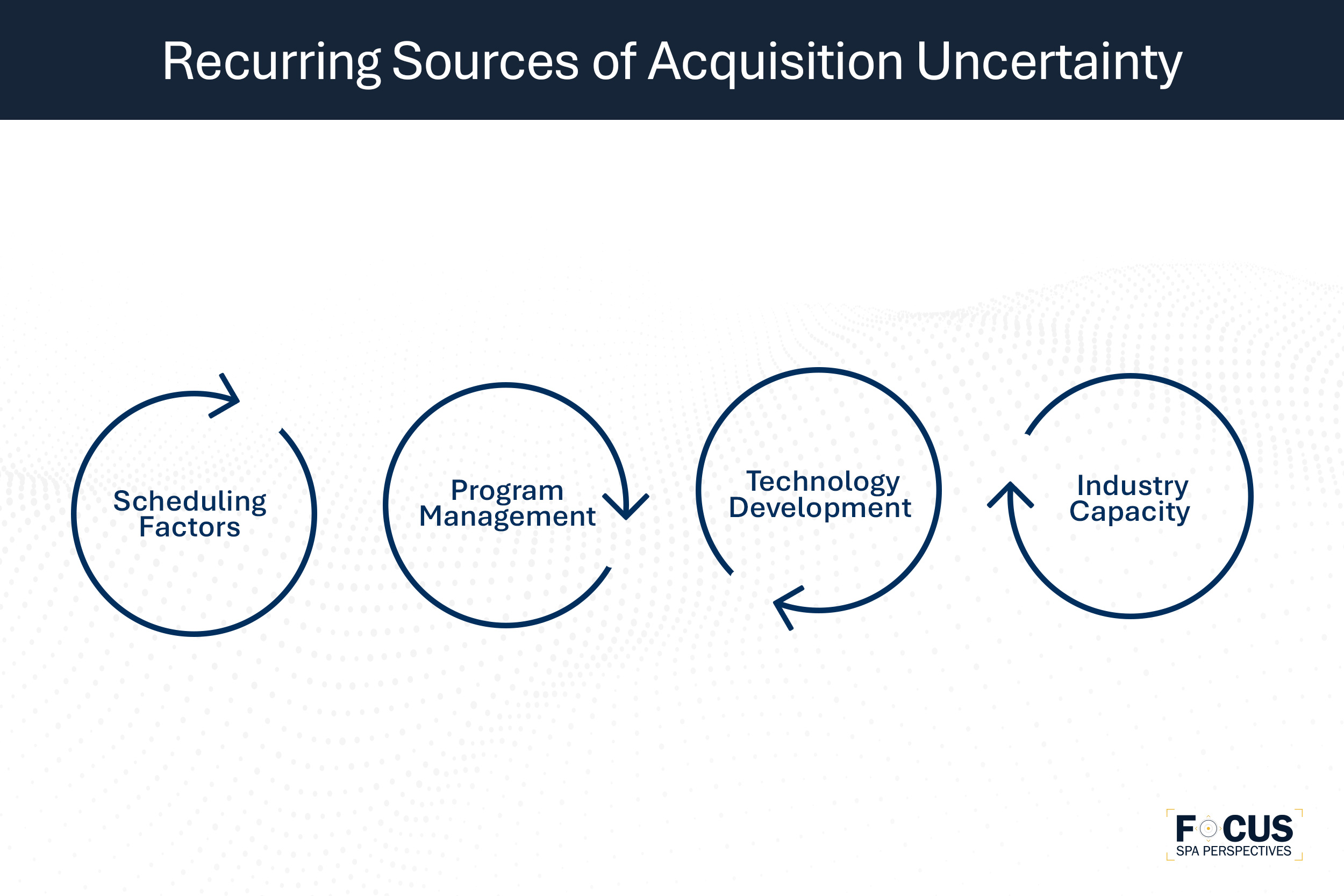
Many of those challenges, Gwenevere explained, can be traced to recurring factors, including industry capacity, technology development, program management, and scheduling pressures.
That observation became part of the foundation for the research. Rather than focusing on a single program outcome, the presentation explored how recurring sources of uncertainty can be identified and documented throughout a program’s lifecycle.
Every estimate is built on available information, assumptions, and professional judgment.
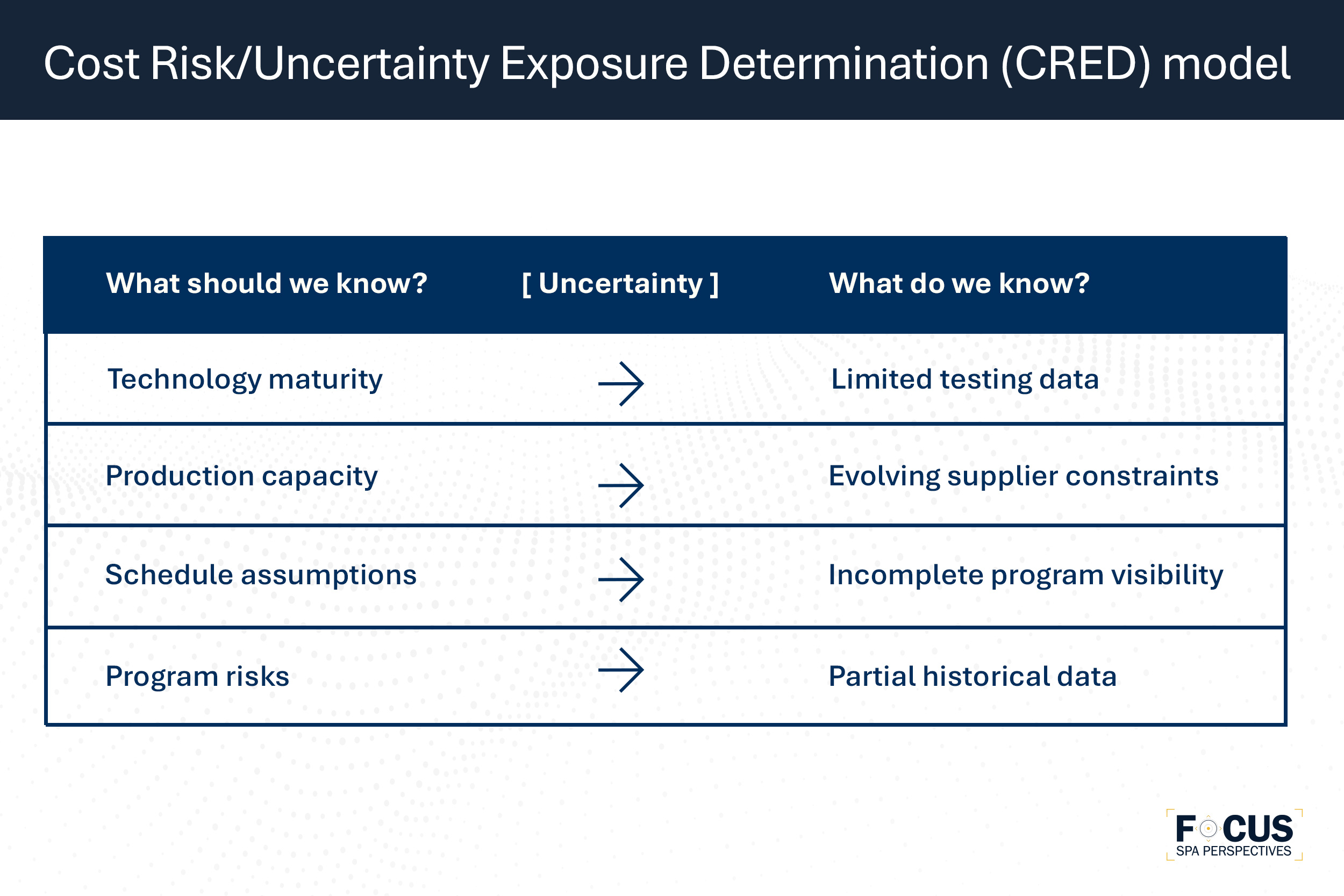
The Cost Risk/Uncertainty Exposure Determination (CRED) model provides a structured approach to assessing uncertainty. Originally developed for software sustainment estimates, the framework centers on two questions:
The model uses those questions to identify areas of uncertainty and exposure.
The presentation also explored how the framework could be adapted beyond software sustainment and applied to shipbuilding programs. Areas examined included scheduling, technology development, systems engineering considerations, industry capacity, and program management.
The approach does not attempt to remove uncertainty from a program. It provides a structured way to examine it.
One theme surfaced repeatedly during the discussion: uncertainty is often easier to recognize than it is to communicate.
Cost analysts spend significant time evaluating assumptions, risks, and unknowns. Decision-makers, meanwhile, balance budgets, schedules, requirements, and competing priorities.
Bridging that gap can be difficult.
Russell McCawley, SPA Cost Analyst
Russell noted that the model provides a way to document uncertainty and track how it changes over time.
The framework also creates a common point of reference for discussing uncertainty as programs evolve and additional information becomes available.
The research examined how uncertainty can be identified, documented, and evaluated within acquisition programs.
Using the DDG-1000 case study and the CRED model, the presentation explored recurring sources of uncertainty and how those factors can be incorporated into a structured analytical framework.
The two questions at the center of the model remain straightforward:
What should we know?
What do we know?
The answers provide a starting point for examining uncertainty and exposure across a program.
Gwenevere Tirpak has served as a Cost Analyst supporting multiple Navy programs over the past two years. Previously, she worked as an Operations Research Analyst specializing in modeling and simulation. Gwenevere holds a Master of Science in Data Science, a Bachelor of Science in Mathematical Physics, and a Bachelor of Arts in Actuarial Science.
Russell McCawley is a Cost Analyst who transitioned into the field in 2024 after beginning his career as an Intelligence Analyst. A 2024 graduate of James Madison University with a Bachelor of Science in Economics, Russell has quickly developed his expertise through collaboration with experienced cost estimating professionals and analysts.
We respect your privacy.
[ Related Articles ]