From Viable to Defendable: Designing Programs That Deliver

In defense acquisition, selecting the best technical solution is not enough. Success depends on how well that choice holds up under scrutiny—from oversight bodies, Congress, and operational users alike—while ensuring the program performs as intended. That’s where the traditional approach to Analysis of Alternatives (AoA) falls short.
In this post, I’ll outline a methodology that helps Department of Defense (DoD) decision-makers move from choosing a viable technical option to building a defendable and executable one. This approach integrates technical performance with programmatic execution metrics to reveal which alternatives are not just operationally effective, but realistically achievable within budget and schedule constraints.
Rethinking AoA: Why Executability Matters
A typical DoD Analysis of Alternatives compares multiple options for meeting a validated capability or mission need. AoAs are a required part of the Joint Capabilities Integration and Development System (JCIDS), which guides how capability gaps are identified, assessed, and resolved. The AoA assesses each option’s operational effectiveness (OE), suitability, and life-cycle cost (LCC). But often, these analyses lean heavily on technical performance metrics while neglecting the real-world challenges of execution.
Yet, the Government Accountability Office (GAO) continues to cite schedule delays, cost growth, and knowledge gaps in major defense acquisition programs (MDAPs). In its 2023 Weapon System Annual Assessment, the GAO reported $37 billion in added cost and average schedule slips of 12 months across active programs. Delays like the FAA has experienced with the NextGen ATC implementation can threaten the entire program, even after significant investments have been made. This is not new—the GAO has reported similar issues for more than twenty-five years.
The implication is clear: technical performance alone doesn’t deliver results. Programs must be executable.
The Hidden Drivers: Programmatic Metrics in AoA
To better support decision-making, we propose enhancing the AoA framework by incorporating programmatic utility—a set of attributes that measure a program’s likelihood of successful execution.
In addition to traditional operational effectiveness metrics like reliability, availability, and range, we include:
- Schedule Confidence – The probability of meeting key program milestones.
- Technology Readiness Level (TRL) – A nine-point scale that assesses maturity of critical technologies.
- Program Risk – The overall likelihood of encountering issues in integration, manufacturing, or demonstration
- Quality and Suitability – Factors affecting ease of fielding, including supportability, human factors, and maintainability.
Together, these metrics provide a clearer picture of whether a program is not only optimal on paper but also likely to be delivered on time, within budget, and with acceptable levels of risk.
A Structured Approach: Using AHP for Integrated Decision-Making
To integrate these metrics, we use the Analytic Hierarchy Process (AHP)—a proven decision-analysis tool that breaks down complex decisions into a hierarchy of criteria and weighs their relative importance.
This method allows us to:
- Decompose the problem into technical, programmatic, and cost elements.
- Use pairwise comparisons to establish the relative importance of each factor.
- Synthesize a single utility score—or visualize the trade space in multi-dimensional form.
This approach is reflected in the figure on the right, which separates operational effectiveness and programmatic utility into distinct dimensions. This structure enables more transparent sensitivity analysis and highlights attributes that might otherwise remain hidden in traditional, performance-heavy AoAs.
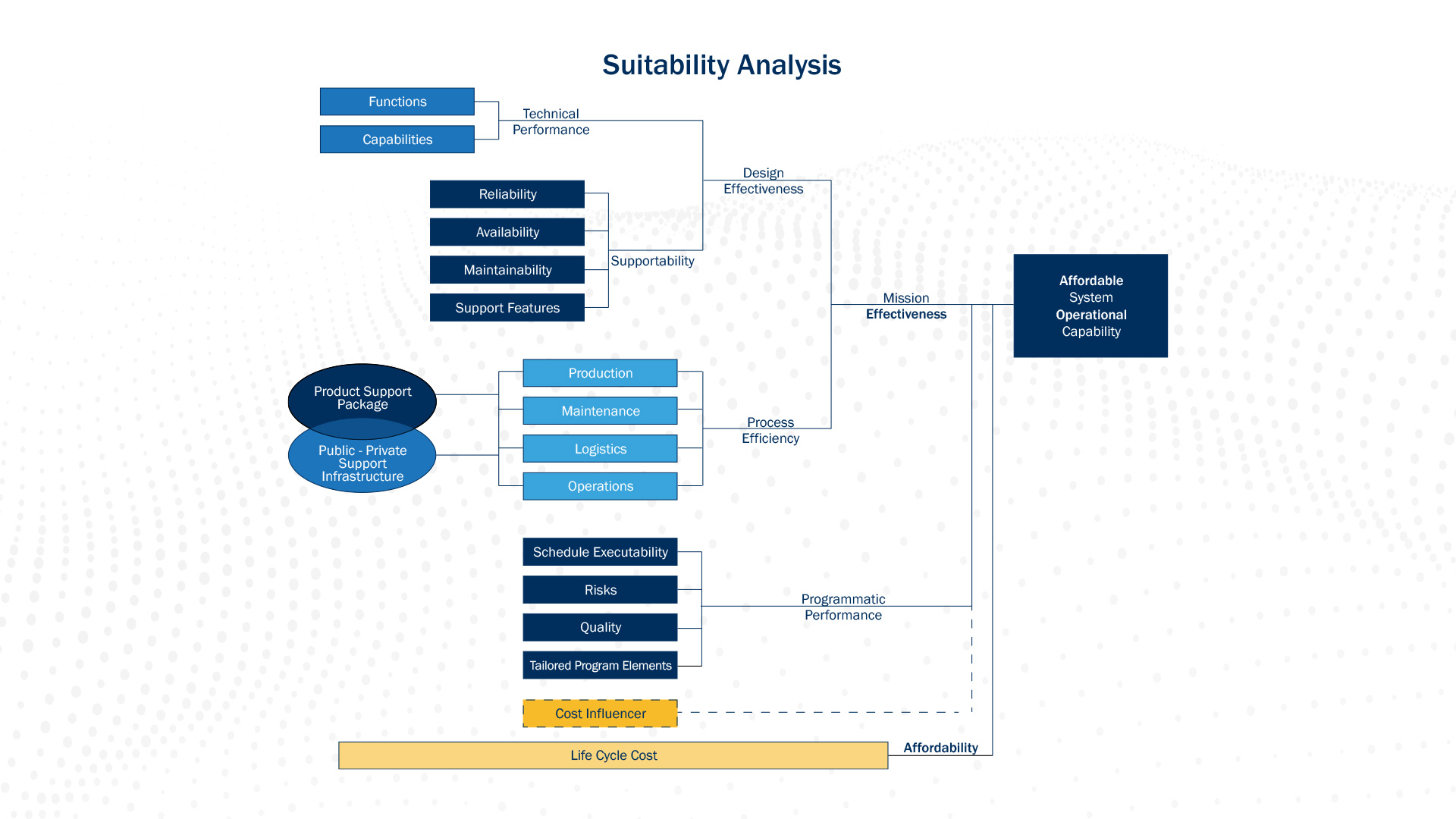
In many AoAs, traditional metrics may favor technically ambitious solutions. But when programmatic utility and cost are added to the equation, those same alternatives can fall behind better-balanced, more executable options.
Visualizing the Trade Space
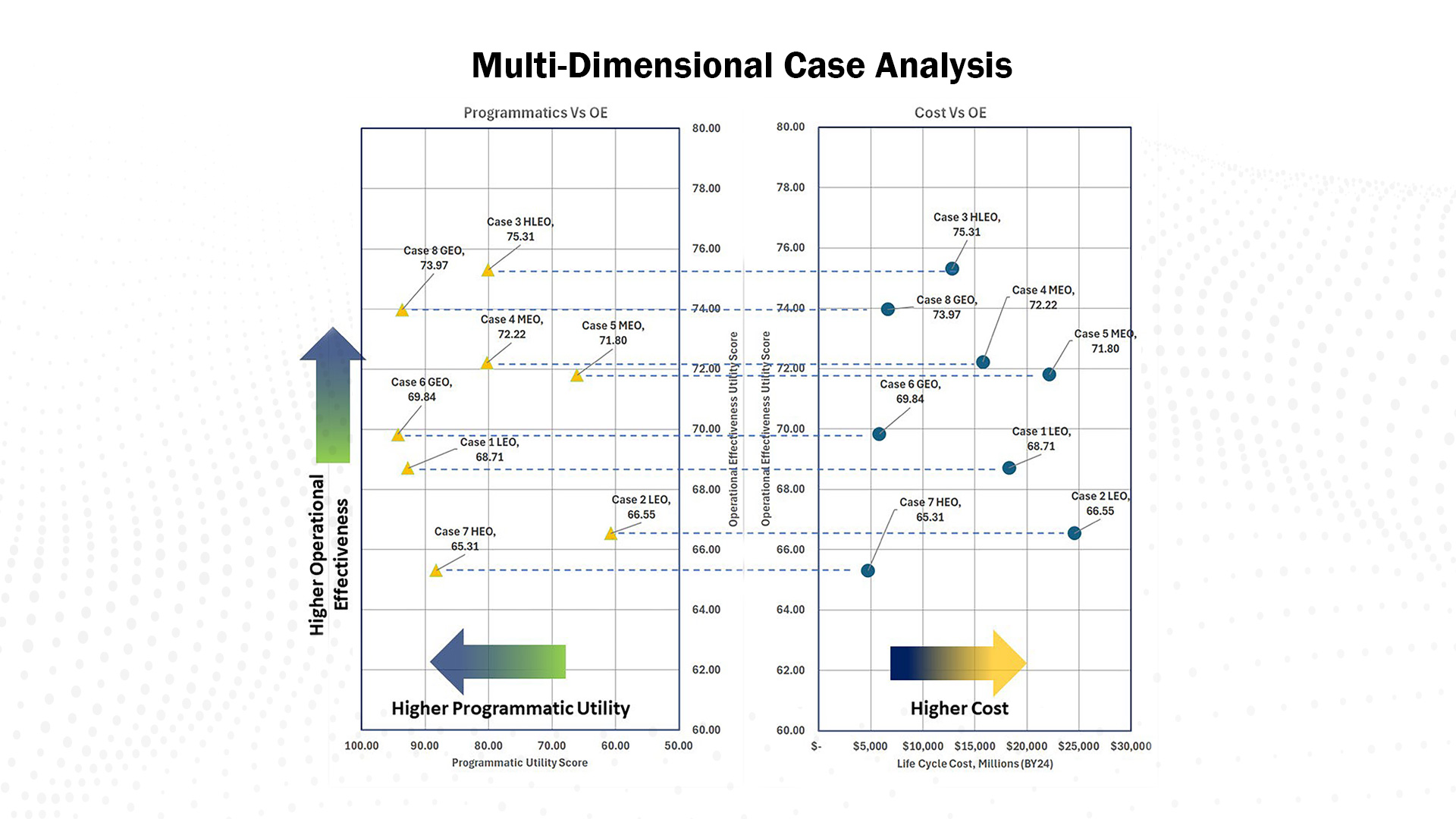
To help decision-makers grasp these trade-offs, we use visual models that plot utility (performance) against cost and optionally add a third axis for programmatic utility. The figure below shows how the top-ranked solution changes depending on whether the focus is purely technical, includes programmatic factors, or includes cost. This type of visualization does more than compare options—it illuminates execution risk in a way traditional AoAs cannot. That visibility is essential for program managers responsible for delivering capability on time and within budget. For that reason, it is ideal for briefings where multiple stakeholders need to understand the basis for trade-offs.
Implications for Program Management and Oversight
By adopting this holistic approach to AoA, DoD program leaders and acquisition professionals gain:
- Greater transparency in how weighting decisions affect outcomes.
- Stronger alignment with execution realities—critical for MDAPs and MT As (Middle Tier Acquisitions Pathway).
- Defendable justifications for milestone reviews, including Milestone B (which marks readiness to enter system development and demonstration).
- Improved outcomes in terms of cost, schedule, and mission effectiveness.
This method also supports Integrated Program Management (IPM) by revealing hidden risks and schedule sensitivities early—before a program becomes locked into a path that may be technically sound but logistically impractical.
From Analysis to Action
In today’s acquisition environment, success is judged not only by what a system can do, but by whether the program will deliver on time and within budget. A viable solution may pass technical muster, but a defendable one survives real-world scrutiny.
By expanding the AoA framework to include programmatic utility and cost influencers—structured objectively through AHP—we equip decision-makers to navigate complexity with confidence—and choose programs that deliver.
Learn about all of SPA’s core capabilities and contact us to learn how SPA supports executable acquisition strategies through advanced Analysis of Alternatives and integrated program management.
Subscribe to our newsletter
We respect your privacy.
[ Related Articles ]