When Complexity Outpaces Traditional Optimization

When Complexity Outpaces Traditional Optimization
00:00

Every mission architecture begins with a series of decisions. Together, those decisions create an expanding set of possible solutions.

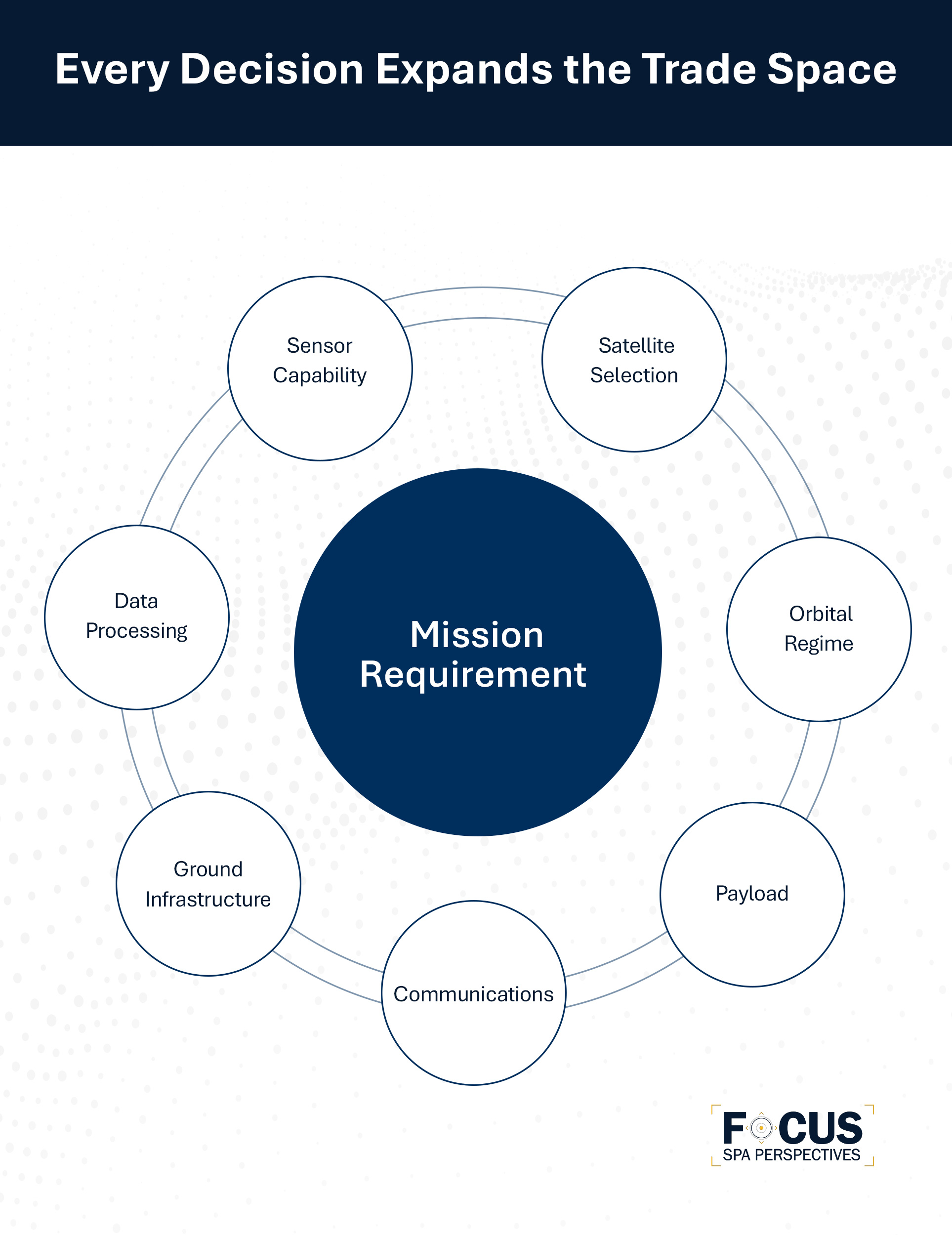
Which satellites belong in the constellation? Which orbital regime best meets the mission? Does greater payload performance outweigh faster data processing? None of those decisions exist in isolation. Each one expands the number of possible architectures, creating a trade space that quickly becomes too large to evaluate exhaustively.

That challenge framed a recent presentation by Shane Vigil, SPA Fellow for Modeling and Simulation, and SPA Operations Research Analyst Noah Sezzi during the Military Operations Research Society (MORS) Symposium. Their work explored how evolutionary analysis can evaluate increasingly complex satellite service architectures through a representative, unclassified problem that demonstrates the methodology without revealing operational details.

SPA branding element for a quotation, a yellow square with a midnight blue quotation mark
“The issue is time complexity. The architectural trade space is only getting bigger and many traditional optimization approaches would take too long to reach a solution.”

Noah Sezzi, Operations Research Analyst

When the Trade Space Keeps Growing

Satellite service architectures extend well beyond satellites themselves. Orbital regimes, payload capabilities, communication layers, ground station infrastructure, data processing, and mission delivery all influence overall performance. Every additional design decision expands the trade space, increasing the number of possible architectures that must be evaluated.

Every additional architecture decision expands the number of possible solutions that operations research must evaluate.

Those analytical challenges align closely with SPA’s Mission and Operations Research Analysis capability, where advanced modeling and simulation, digital engineering artifacts, and disciplined analytical methods transform technical data into decision-quality insight. Through end-to-end mission modeling, analysts evaluate complex systems, missions, and campaigns before critical decisions are made.

Related Perspective: Closing the Gap Between Demand and Capacity in Naval Force Design

Analytical tradeoffs extend well beyond space architectures. Explore how rigorous analysis informs force design decisions across increasingly complex operational environments.

Building a Representative Problem

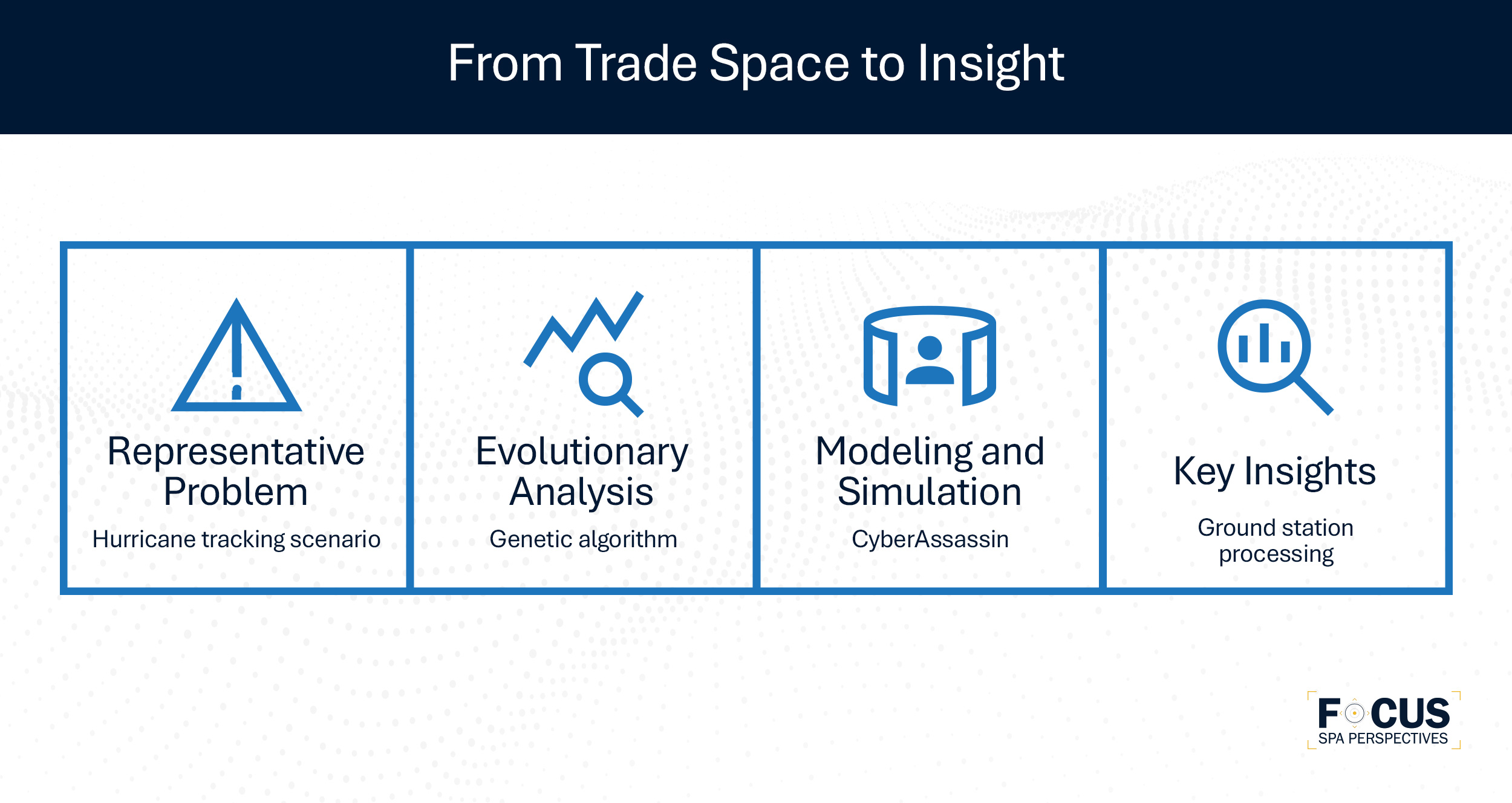
To evaluate the methodology publicly, Shane and Noah developed a notional hurricane tracking scenario that reflected the complexity of a modern satellite service architecture without representing an operational mission. Multiple satellite constellations, orbital regimes, ground stations, communication pathways, and processing timelines created a representative trade space for analysis. Candidate architectures were evaluated against accuracy and latency requirements to identify those capable of meeting mission objectives.

To efficiently navigate the representative trade space, Shane and Noah selected a genetic algorithm capable of producing “good enough, fast enough” solutions while supporting mission-level modeling and simulation. SPA combines operations research with advanced modeling and simulation, leveraging technologies such as CyberAssassinTM and other tools to evaluate complex mission problems and generate decision-quality insight.

The representative problem created a practical way to refine, validate, and discuss the analytical approach within an unclassified environment before applying it elsewhere.

The methodology identified promising architectures while revealing the characteristics that most influenced performance.
Understanding the Results

Identifying which satellite service architectures were best positioned in both time and space to achieve mission success answered the first analytical question.

The analysis then examined a second question: what characteristics consistently made those architectures successful?

Using Classification and Regression Trees (CART), Shane and Noah identified the attributes that most influenced higher-performing solutions. Within the representative scenario, payload sensor field of regard and ground station processing time emerged as the strongest contributors to architecture performance.

Which satellite service architectures are best positioned to achieve mission success?
  • What characteristics consistently make those architectures successful, and how can those insights inform future architecture decisions?

  • The lessons extended beyond the notional scenario. Model inputs proved just as important as the analytical methods themselves. Results remained dependent on the quality of the assumptions, data, and conditions used to build the model.

Looking ahead, Shane and Noah identified additional opportunities to incorporate client preferences, cost analysis, different orbital starting conditions, and comparisons with other evolutionary algorithms. The same analytical principles extend throughout SPA’s Mission and Operations Research Analysis capability, where operations research, advanced modeling and simulation, and a portfolio of technologies including CyberAssassin™, SPA-developed STORM and SWIFT, and AthenaSight™ enable rigorous analysis across complex systems, missions, and campaigns.
Related Perspective: Gaming to Win: Expanding the Role of Digital Wargaming

Digital environments continue to expand how organizations analyze complex operational problems, accelerate iteration, and capture decision-quality insight before execution.

Explore the Capability: Mission and Operations Research Analysis equips decision-makers with the clarity and foresight required to make critical decisions in complex environments through advanced modeling and simulation, operations research, campaign analysis, digital engineering, and digital wargaming.

Share

In this article:

SPA Fellow Shane Vigil Headshot

Shane Vigil is SPA’s Fellow for Mission Operations Research Analysis – Modeling and Simulation. He specializes in operations research, modeling and simulation, and space mission engineering, applying advanced analytical methods to evaluate complex systems and inform mission-critical decisions across the Department of War and Intelligence Community.

Noah Sezzi is an Operations Research Analyst at SPA whose work focuses on space systems, modeling and simulation, and analytical methods for evaluating complex architectures. He holds a Bachelor of Science in mechanical engineering from San José State University.

Subscribe to our newsletter

We respect your privacy.

[ Related Articles ]