From Silos to Systems: How Collaboration Can Strengthen America’s Semiconductor Future

America is at a crossroads when it comes to its semiconductor future. Billions of dollars are being invested, alliances are being tested, and the stakes for national security have never been higher. Yet despite the urgency, too many efforts remain disconnected, fragmented, and siloed.
“We need to move from silos to systems,” says Christian Cabaniss, military operations analyst at Systems Planning & Analysis (SPA) and USMC Col Ret. “Right now, too many parts of this effort are being managed in isolation. That’s a strategic vulnerability we can’t afford.”
Over the first three posts in this series, we’ve explored the global interdependence of the semiconductor ecosystem, examined the difference between risk and uncertainty in defense planning, and identified infrastructure barriers that often go unseen. Each of these threads points to a central truth: America cannot secure its semiconductor future alone. It will take partnerships between industry and government, across levels of government, and among international allies.
The Need for Holistic Planning
For decades, semiconductor production was viewed primarily through an economic lens. Even today, as strategic competition sharpens and vulnerabilities become clearer, national security planning often remains compartmentalized. “The semiconductor problem doesn’t sit neatly within the Department of Defense, the Department of Commerce, or the Department of Energy alone,” Cabaniss explains. “It touches all of them—and the private sector too.”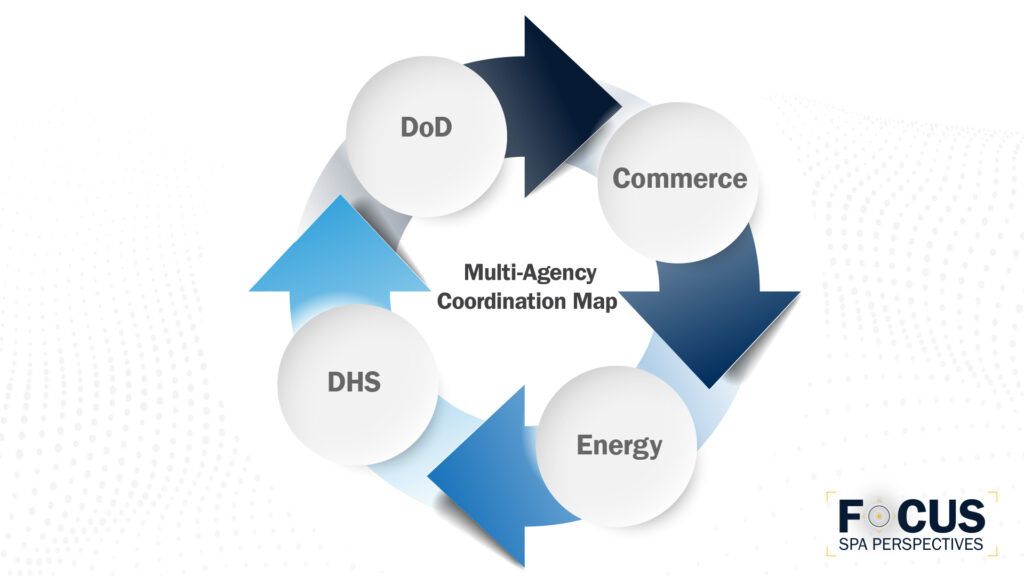
Building resilience requires alignment across agencies with different missions, budgets, and cultures. Without that coordination, investments risk being duplicated, delayed, or disconnected from broader national goals.
What Government Can Do
Federal leadership plays a pivotal role. While companies will continue to drive innovation and competition, only government can set long-range strategy, unify disparate efforts, and ensure resilience is built into every layer.
Key priorities include:
- Establishing Shared Objectives: Agencies must align on what semiconductor resilience means in practical terms—including supply chain diversification, workforce development, and strategic reserves—not just increasing domestic fab count.
- Leveraging Procurement Power: Defense and civilian agencies can structure contracts to promote a broader supplier base and long-term sourcing stability.
- Coordinating Incentives: Tax policy, research grants, and industrial funding must be synchronized to avoid fragmentation and missed opportunities.
What Industry Must Bring to the Table
The private sector must move beyond short-term thinking. Semiconductor resilience requires long-view planning, looking years ahead, not just quarters.

“Industry leads innovation, but government shapes the playing field. We need the two talking not just at senior executive levels, but where real decisions about sourcing, logistics, and engineering are made.”
Christian Cabaniss, a military operations analyst with SPA and USMC Col Ret
To that end, companies must:
- Share non-proprietary supply chain data to help identify weak points
- Engage in scenario planning with federal partners
- Support workforce training initiatives to meet future demand
- Invest in redundancy even when margins tighten
Allies Matter More Than Ever
While reshoring has its place, the U.S. will always depend on international partners. Key nodes in the semiconductor supply chain, such as extreme ultraviolet (EUV) lithography in the Netherlands, wafer production in Japan, and advanced testing in South Korea, are not easily replicated.
“Isolation isn’t the answer,” says Cabaniss. “Strength comes from alignment with like-minded partners who share our security and economic interests.”
That alignment requires more than diplomatic handshakes. It demands:
- Shared export control policies
- Standardized cybersecurity practices
- Joint investment in resilient supply hubs
- Frequent coordination between allies, not just bilateral agreements
A Call for Systems Thinking
The United States has the talent, capital, and strategic position to lead in semiconductors—but only if it embraces a systems approach.
That means:
- Integrated Planning: Semiconductor resilience must be incorporated into defense, industrial, energy, and diplomatic strategies, not treated as a standalone goal.
- Continuous Dialogue: Public-private forums and multinational working groups must operate proactively, not just reactively.
- Long-Term Vision: Policymakers and industry leaders must avoid the trap of quick wins and invest in enduring capacity, even when the payoff is a decade away
“We’re the worldwide leader in innovation,” Cabaniss concludes. “The question is whether we’re willing to lead in the hard work of building systems that can stand the test of time.”
Christian Cabaniss, a military operations analyst with SPA and USMC Col RetExplore the Series
This post concludes our four-part exploration of semiconductors and national security. If you missed a post, catch up here:
That means:
- Part 1: Beyond the Chip – Why America’s security depends on the entire global semiconductor ecosystem
- Part 2: Risk vs. Uncertainty – How flexible planning, not prediction, must shape
- Part 3: Infrastructure Matters – Why fabs are only as strong as the systems that support them
Subscribe now so you can be among the first to get new posts. We respect your privacy and inbox, sending no more than one email per week.
Subscribe to our newsletter
We respect your privacy.
[ Related Articles ]