From Overconfidence to Realism: Overcoming Bias in Early Cost Forecasting

In March 2025, Systems Planning & Analysis (SPA) experts Patrick Malone and Christina Snyder, ICEAA Board President and SPA’s Fellow for Cost Estimation and Analysis, along with clinical psychologist Benjamin Snyder, PhD, presented groundbreaking insights at the IEEE Aerospace Conference in Big Sky, Montana, in their presentation “Evaluating and Minimizing Cost Estimating Bias Early in Program Development.” This article is based on their presentation and accompanying abstract.
Navigating the complex landscape of program cost estimation requires confronting hidden biases that threaten budgets, timelines, and ultimately mission success. Accurate cost estimating is critical for defense programs aiming to deliver on time, within budget, and with the capabilities needed for today’s warfighter. Yet, cost estimation—especially early in the acquisition process—is often undermined by inherent biases that lead to budget overruns and delayed fielding. Understanding these biases and proactively addressing them significantly improves the accuracy and reliability of cost forecasts.
The Challenge of Early Cost Estimating
Creating accurate cost estimates at the early stages of program development is particularly problematic because mission requirements continually evolve, technological paths remain unclear, and stakeholder pressures intensify. Frequently, initial estimates reflect a mix of over-optimism, unrealistic goals, and incomplete assessments of technology maturity and program risks.
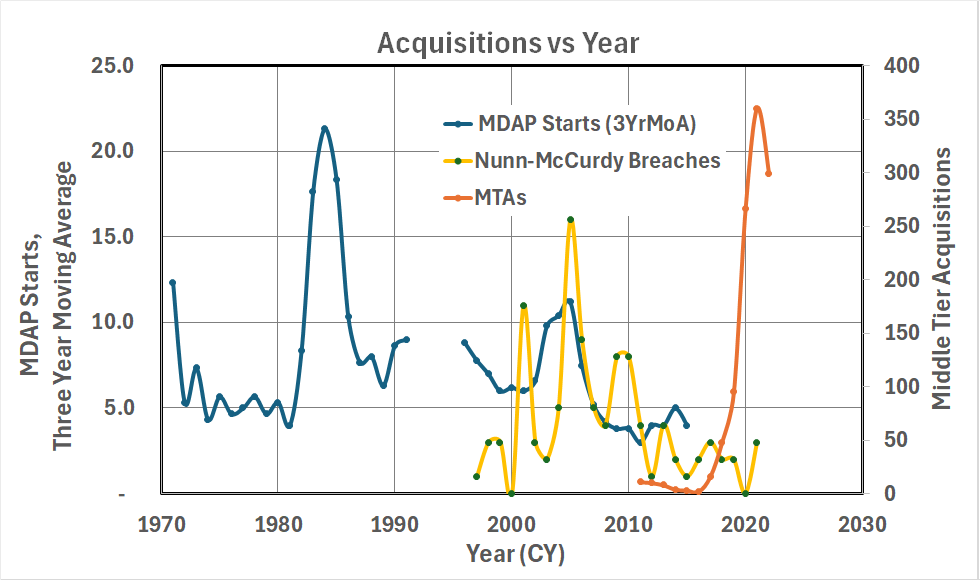
A notable example is the historical occurrence of significant cost overruns in Major Defense Acquisition Programs (MDAPs), as exemplified by recurring Nunn-McCurdy breaches. Despite initiatives like Middle Tier Acquisitions (MTAs), designed to streamline processes and reduce risk, the underlying issue of cost growth persists. Biases—intentional or not—continue to infiltrate estimations, negatively impacting resource allocation and strategic decision-making.
Why Early Cost Estimating is Difficult
Early-stage cost estimates present numerous challenges primarily due to the dynamic nature of program requirements and uncertainty in the technology and implementation pathways. Stakeholders must frequently estimate costs based on limited or incomplete information about system requirements, technological maturity, and eventual mission environments. Additionally, budget constraints, external pressures from stakeholders, and internal organizational dynamics often compound these difficulties, resulting in estimates that can skew significantly from eventual reality.
Common Sources of Bias in Cost Estimation
Our research identifies several prevalent biases affecting cost estimates:- Over-Optimism: Excessive confidence in technology readiness and minimal acknowledgment of risks or complexities.
- Group Think: Decisions made to maintain group harmony, suppressing dissent or creative problem-solving.
- Dominating Personalities: Forceful opinions overshadowing comprehensive analysis, suppressing diverse perspectives and reducing the overall quality of estimates.
- Inexperience: Limited familiarity with complex systems, historical data, or proven methodologies, leading to oversight and unrealistic expectations.
- Pressure from Management: Demands for success at any cost, distorting realistic forecasting by incentivizing optimistic rather than realistic estimations.
- Data Bias: Errors from incomplete, irrelevant, inaccurately interpreted, or selectively used data, contributing to inaccurate foundational assumptions.
As highlighted by the GAO Cost Estimating Guide, these biases collectively or independently have the potential to significantly skew early estimates, undermining reliability and credibility.
Negative Impacts of Bias on Defense Programs
The impacts of these biases are significant, with wide-ranging consequences for defense programs. For example, biases can manifest in:
- Budget Overruns: Optimistic estimates can lead to insufficient budgeting, causing programs to exceed their allocated funds and potentially trigger Nunn-McCurdy breaches.
- Schedule Delays: Failure to accurately account for technology readiness and risk can result in unforeseen delays, hindering timely delivery of critical capabilities.
- Capability Shortfalls: Overconfidence or group think can cause critical design and operational risks to be underestimated, resulting in delivered capabilities that fail to meet mission requirements.
- Strategic Misalignment: Bias-driven inaccuracies in cost estimation can distort resource allocation decisions, diverting attention and funding away from other potentially more impactful projects.
Rigorous Processes for Mitigating Bias
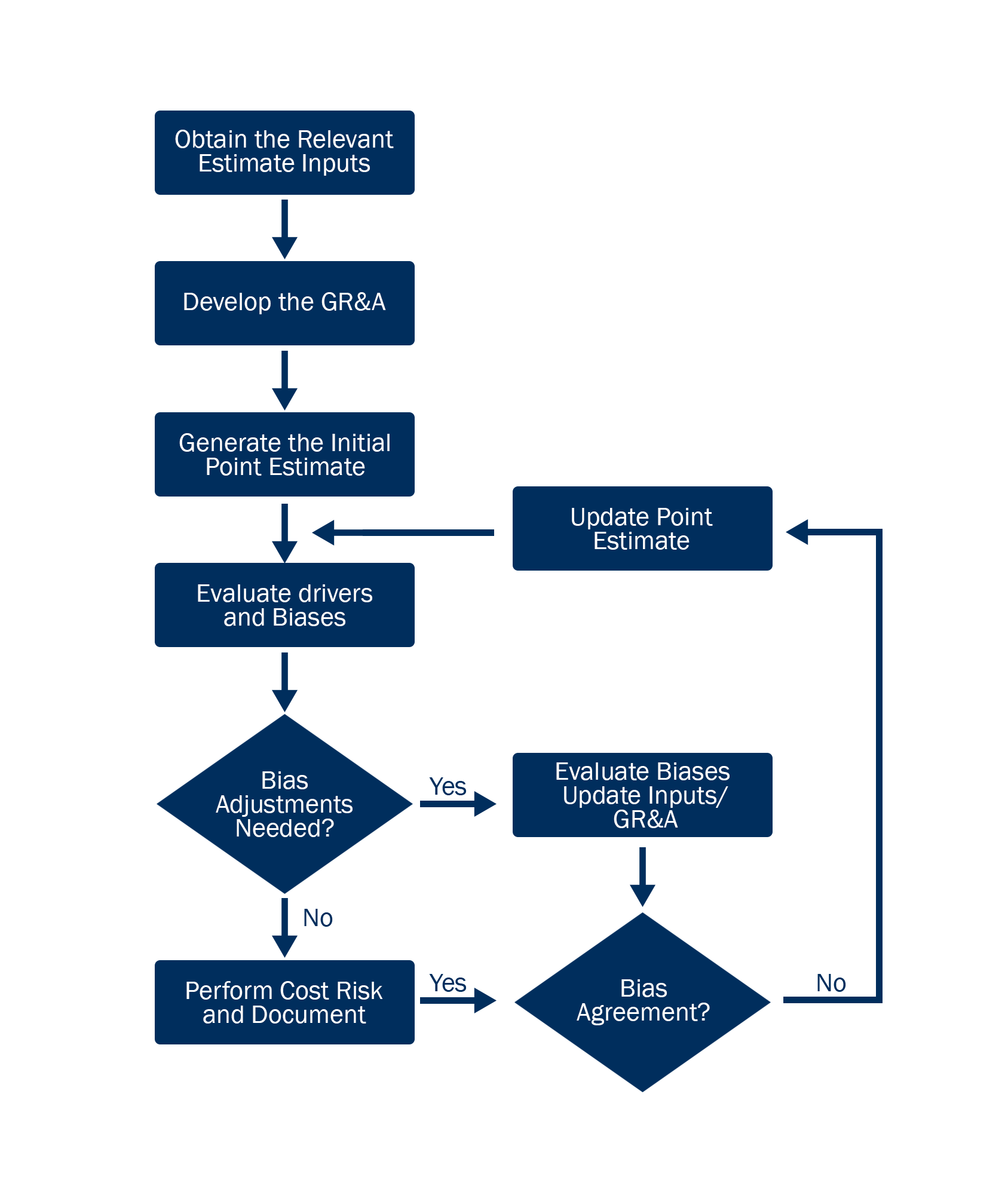
All estimates contain bias. To overcome this, one must acknowledge the existence of bias to move beyond it and develop mitigation strategies to apply objective data-driven inputs. A first step in developing an objective balanced cost estimate is to gather and structure the estimate using proven processes. The figure below illustrates a bias evaluation process following point estimate development to determine a) if there is bias and b) where it might be present.
At SPA, one of our central capabilities is Cost Research, Estimating, and Engineering. Within this analytic discipline, we emphasize using a structured, methodical approach that integrates psychological insights with rigorous analytic methods. Our approach involves these steps:
- Critical Thinking and Pre-Mortems: Encourage stakeholders to challenge assumptions by explicitly exploring scenarios in which the project fails. This process helps to proactively identify risks and develop mitigation strategies.
- Structured Decision-Making: Employ frameworks such as SWOT analyses or structured round-robin discussions to help ensure balanced and inclusive input by systematically engaging all participants.
- Weight-of-Advice (WOA) and Judge-Advisor Systems (JAS): Incorporate structured processes that objectively evaluate stakeholder inputs based on expertise, credibility, and relevance. These methods help mitigate biases by assigning objective weights to various stakeholder contributions.
- Quantitative Risk Assessment: Enhance initial point estimates using probabilistic techniques such as Monte Carlo simulations, explicitly modeling uncertainties and providing a clearer picture of potential risks.
Managing Group Think and Dominating Personalities
To effectively manage biases like “group think” and dominating personalities, structured facilitation and deliberate engagement strategies like these are essential:
- Structured Agendas: Clearly defining meeting agendas with specific time allocations and targeted participation from all group members can ensure balanced inputs.
- Round-Robin Discussion: Utilizing round-robin methods ensures each participant has an equal opportunity to voice insights, reducing the impact of dominating personalities.
- Mentorship and Pairing: Pairing inexperienced participants with more experienced analysts encourages knowledge sharing and balanced input, reducing the dominance of any single individual or viewpoint.
- Anonymous Input: Collecting input anonymously can help mitigate the effect of dominating personalities and reduce conformity pressures, encouraging more diverse and honest feedback.
Practical Examples of Bias Mitigation
We applied these strategies effectively during a recent cost estimation scenario for a new space mission. Initially, biases from dominating personalities and data ambiguity created significant obstacles. By restructuring meetings to include round-robin discussions, pairing inexperienced analysts with senior counterparts for mentorship, and encouraging critical review through pre-mortem exercises, we reached a balanced consensus on the project’s cost inputs.
We also implemented the Weight-of-Advice (WOA) method, enabling stakeholders to anonymously rate each participant’s expertise, significantly reducing the influence of dominating personalities. This structured approach led to balanced discussions and produced high-quality cost inputs, grounded in objective data rather than individual biases.
Continuous Improvement and Future Research Directions
Bias mitigation is not a static task but an ongoing commitment to continuous improvement. At SPA, we advocate regular reviews of estimates, continuously updating assumptions and models as new information emerges. Identifying bias should become an integral part of routine program reviews, systematically revisiting assumptions and adjusting models accordingly.
Recognizing and addressing biases early in program development is essential for accurate cost estimates, mission alignment, and preventing costly delays and overruns. Integrating behavioral insights with rigorous analytical methodologies helps defense organizations produce credible, realistic, and actionable forecasts. With dedicated processes and continual refinements, program leaders can enhance the precision and effectiveness of strategic resource allocations, thereby significantly improving mission outcomes.
Learn more about SPA’s capabilities in Digital Program Management or download our Core Capabilities brochure.
Subscribe to our newsletter
We respect your privacy.
[ Related Articles ]